


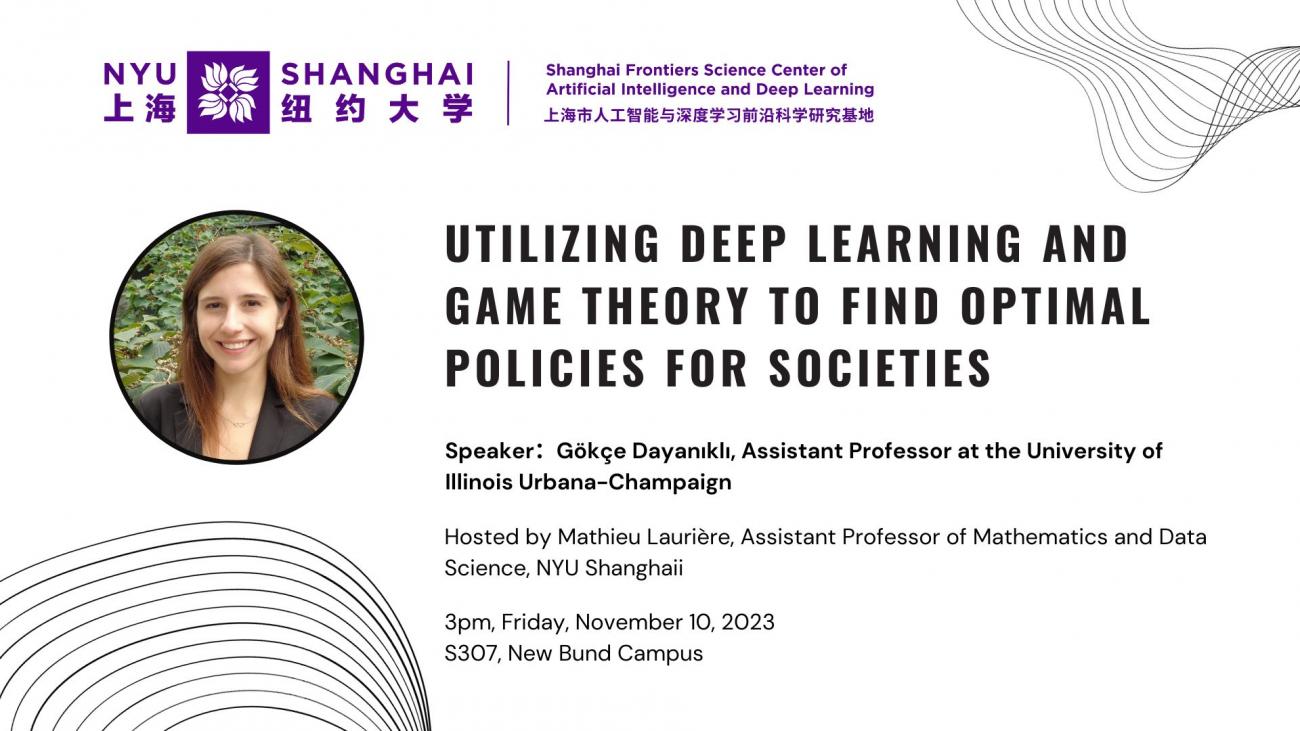
Abstract: In this talk we will discuss how we can utilize deep learning tools to solve complex (dynamic and stochastic) game theoretical problems where there are a large number of agents interacting. We will first introduce a stochastic optimal control problem for one agent and explain how we can use neural networks to solve this problem. Later, we will go to the multi-agent setup and we will discuss and compare two equilibrium notions in game theory: Nash equilibrium and Stackelberg equilibrium. After explaining how a Nash equilibrium can be approximated for dynamic and stochastic games for a large number of players through mean field games, we will explain how neural networks can be used to find the Nash equilibrium. Finally, we will introduce the Stackelberg mean field game model between a principal (i.e., regulator) and a large number of agents to find optimal policies for large societies and discuss how the utilization of deep learning tools can be extended to solve this complex problem. (This is a joint work with Mathieu Lauriere.)
Bio: Gökçe Dayanıklı is an assistant professor at the University of Illinois Urbana-Champaign, Department of Statistics. Before joining UIUC, she was a term assistant professor of Statistics at Columbia University. She completed her Ph.D. in Operations Research & Financial Engineering at Princeton University in 2022 where she was awarded the School of Engineering and Applied Sciences Award for Excellence. During Fall 2021, she was a visiting graduate researcher at the Institute for Mathematical and Statistical Innovation (IMSI) to participate in the "Distributed Solutions to Complex Societal Problems" program.