


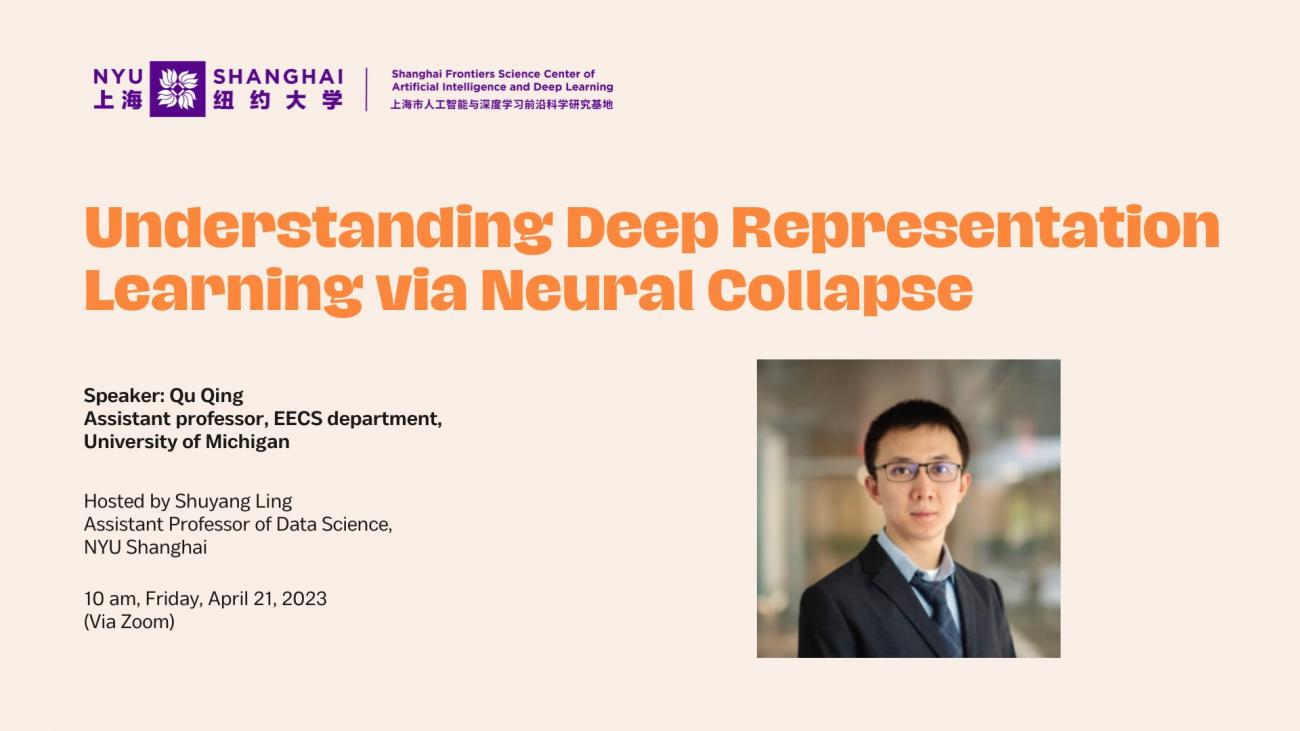
Abstract: Recently, an intriguing phenomenon in the final stages of network training has been discovered and caught great interest, in which the last-layer features and classifiers collapse to simple but elegant mathematical structures: all training inputs are mapped to class-specific points in feature space, and the last-layer classifier converges to the dual of the features’ class means while attaining the maximum possible margin. This phenomenon, dubbed Neural Collapse, persists across a variety of different network architectures, datasets, and even data domains. Moreover, a progressive neural collapse occurs from shallow to deep layers. This talk leverages the symmetry and geometry of Neural Collapse, and develops a rigorous mathematical theory to explain when and why it happens under the so-called unconstrained feature model. Based upon this, we show how it can be used to provide guidelines to understand and improve transferability with more efficient fine-tuning.
Speaker Bio: Qing Qu is an assistant professor in EECS department at the University of Michigan. Prior to that, he was a Moore-Sloan data science fellow at Center for Data Science, New York University, from 2018 to 2020. He received his Ph.D from Columbia University in Electrical Engineering in Oct. 2018. He received his B.Eng. from Tsinghua University in Jul. 2011, and a M.Sc.from the Johns Hopkins University in Dec. 2012, both in Electrical and Computer Engineering. He interned at U.S. Army Research Laboratory in 2012 and Microsoft Research in 2016, respectively. His research interest lies at the intersection of foundation of data science, machine learning, numerical optimization, and signal/image processing, with focus on developing efficient nonconvex methods and global optimality guarantees for solving representation learning and nonlinear inverse problems in engineering and imaging sciences. He is the recipient of Best Student Paper Award at SPARS’15 (with Ju Sun, John Wright), and the recipient of Microsoft PhD Fellowship in machine learning. He is the recipient of the NSF Career Award in 2022, and Amazon Research Award (AWS AI) in 2023.
Join Zoom Meeting https://nyu.zoom.us/j/97193028471