


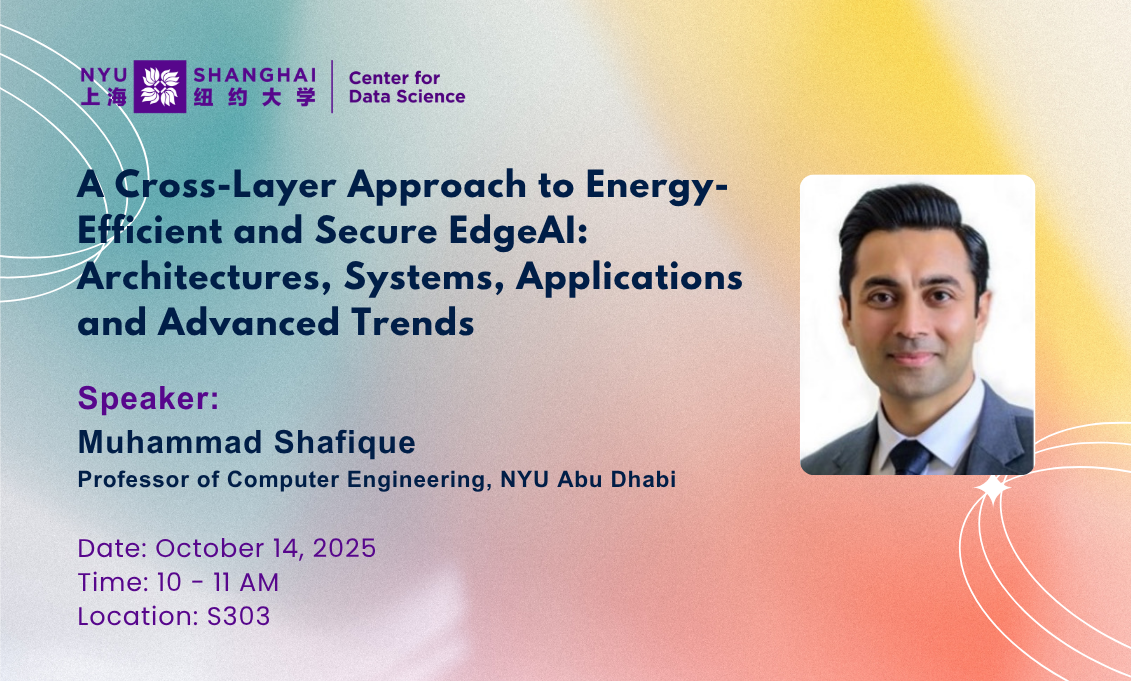
Abstract: Modern Machine Learning (ML) and Artificial Intelligence (AI) approaches, such as Deep Neural Networks (DNNs) and Large Language Models (LLMs), have achieved remarkable accuracy in tasks like image classification, object detection, natural language processing, and generative AI. However, these models demand substantial computation, memory, and energy, posing challenges for building energy-efficient TinyML and EdgeAI solutions on resource-constrained devices. Additionally, growing cybersecurity threats and nano-scale devices introduce new reliability and robustness challenges.
In my eBRAIN and iCAS Labs at NYU Abu Dhabi and NYU Tandon, I investigate foundations for next-generation energy-efficient, secure, and robust AI/ML systems. This talk will cover design challenges and cross-layer techniques for building highly energy-efficient and dependable cognitive systems for EdgeAI applications, enabling deployment in autonomous systems, IoT healthcare/wearables, Industrial IoT, smart transportation, and smart cities. I will also share highlights from our recent projects on Quantum Machine Learning, Continual Learning, Multimodal LLMs, and Agentic-AI, concluding with insights on cutting-edge AI technologies for offensive security.
Bio: Shafique received his Ph.D. degree in Computer Science from the Karlsruhe Institute of Technology (KIT), Germany, in 2011. Afterwards, he established and led a highly recognized research group at KIT for several years as well as conducted impactful collaborative R&D activities across the globe. Before KIT, he was with Streaming Networks Pvt. Ltd. where he was involved in research and development of video coding systems several years. Since Sep.2020, Dr. Shafique is with the New York University (NYU), where he is currently a Full Professor and the director of eBRAIN and iCAS Labs at the NYU-Abu Dhabi, UAE, and a Global Network Professor at Tanson. His research interests are in AI & machine learning hardware and system-level design, brain-inspired computing, EdgeAI, tinyML, multimodal foundation models, agentic-AI, embodied-AI, machine learning security and privacy, quantum machine learning, cognitive autonomous systems, wearable healthcare, AI for healthcare/medical imaging, energy-efficient systems, robust computing, hardware security, emerging technologies, EDA, FPGAs, MPSoCs, embedded systems, and quantum computing.